Mumbai–Navi Mumbai Connectivity Enters a New Era with Metro Line 8 Approval

Mumbai–Navi Mumbai Connectivity Enters a New Era with Metro Line 8 Approval

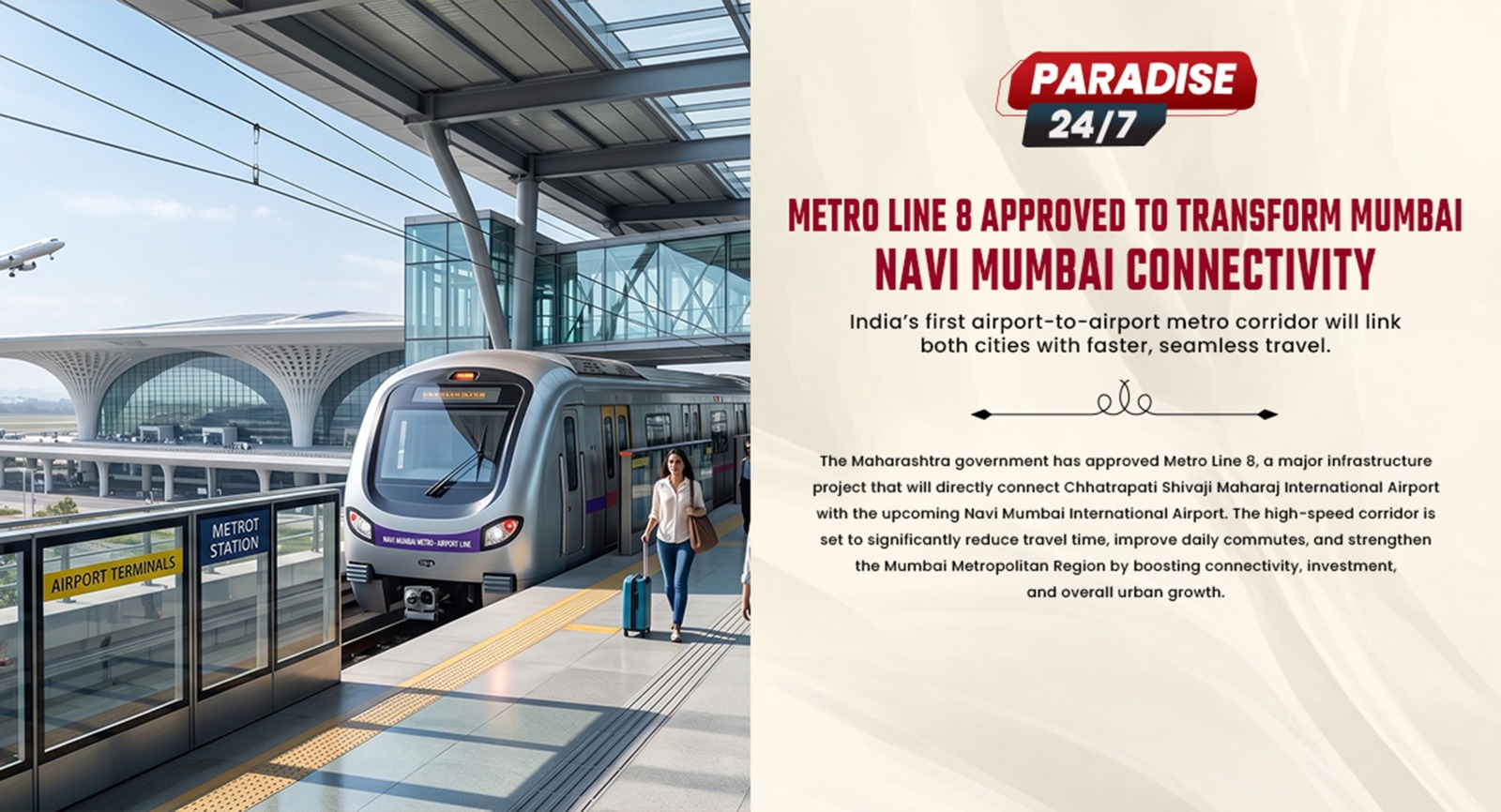
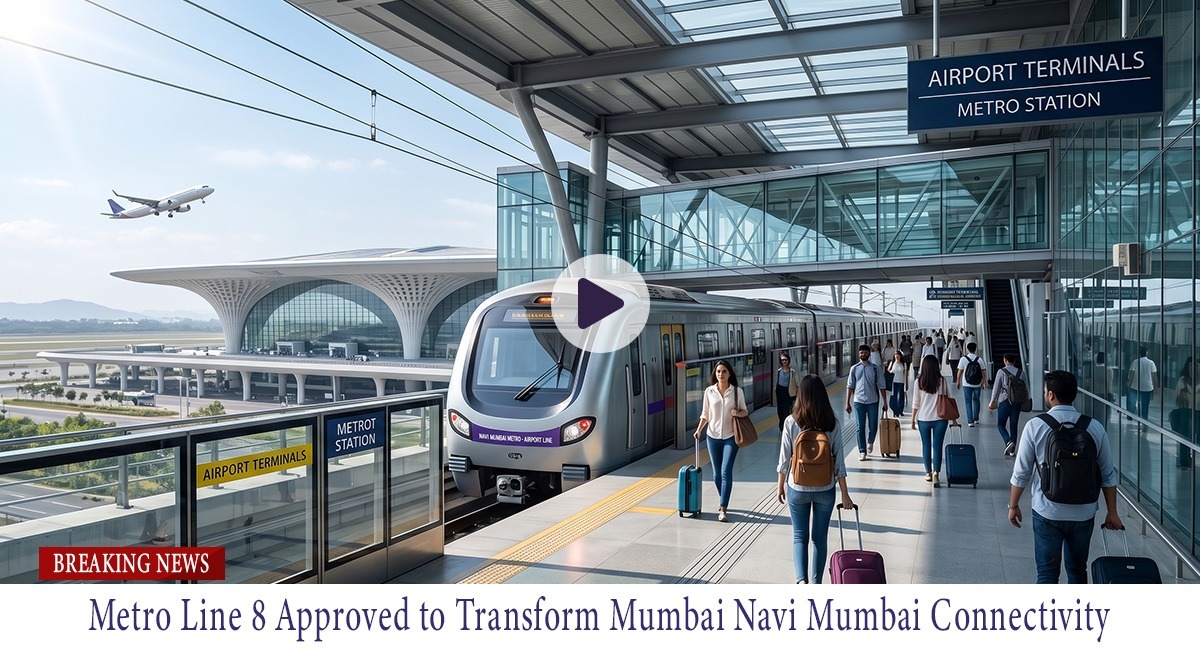
In a landmark move set to transform urban mobility, the Government of Maharashtra has approved Metro Line 8, a mega infrastructure project that will create a high-speed metro link between Mumbai and Navi Mumbai. This strategic corridor is expected to redefine airport connectivity, reduce travel time, and accelerate growth across the entire region.
The announcement marks a significant milestone in strengthening the infrastructure backbone of Mumbai and Navi Mumbai — two cities rapidly evolving into a unified economic and lifestyle hub.
Mumbai–Navi Mumbai Connectivity Enters a New Era with Metro Line 8 Approval

India’s First Airport-to-Airport Metro Corridor

Metro Line 8 will directly connect
Chhatrapati Shivaji Maharaj International Airport to Navi Mumbai International Airport, creating a seamless, high-speed transit link between the two aviation gateways.
Project Snapshot
  • Total Length: 35 km
    • o9.25 km Underground
    • o24.64 km Elevated
  • Total Project Cost: ₹22,862 Crores
  • Execution Model: EPC under PPP
  • Timeline: Expected completion in 3.5 years
  • Stations Planned: 20 stations across the corridor
This project will drastically improve mobility for travellers, professionals, and daily commuters moving between Mumbai and Navi Mumbai.

Why Metro Line 8 Is a Game-Changer

Faster Travel, Predictable Commutes
Road travel between the two airports is often affected by heavy congestion. The metro corridor will cut travel time significantly and offer a reliable alternative.
Seamless Airport Connectivity
Passengers will enjoy:
  • Faster airport transfers
  • Reliable transit during peak hours
  • A world-class travel experience
Decongesting Roads & Promoting Public Transport
The project will reduce traffic pressure on highways and encourage sustainable mobility.
Driving Economic Growth
Mega infrastructure projects often unlock new opportunities. Metro Line 8 is expected to:
  • Create jobs
  • Attract investments
  • Stimulate residential and commercial demand

Strengthening the Mumbai Metropolitan Region

The corridor will become a major mobility backbone for the Mumbai Metropolitan Region, integrating key business districts, residential zones and emerging growth corridors.
With the Navi Mumbai International Airport nearing completion, this metro line will ensure both airports function as a single, efficient aviation ecosystem.

A Huge Opportunity for Navi Mumbai Real Estate

Improved connectivity always drives real estate demand, and this infrastructure upgrade is set to accelerate Navi Mumbai’s transformation into a high-growth residential destination.
Leading developments by Paradise Group are strategically positioned to benefit from this connectivity boom.
Key Projects Positioned for Growth
  • Sai World City
  • Sai Platinum
  • Sai Prerna
  • Sai Sun City
  • Sai World Empire
  • Sai World Pyramid
  • Sai Palm View
These developments offer modern living within the rapidly growing Mumbai–Navi Mumbai corridor, making them ideal for homebuyers and investors looking to benefit from the region’s infrastructure-led growth.

Navi Mumbai’s Growth Story Gets Stronger

With Metro Line 8 set to redefine intercity travel, Navi Mumbai is entering a new phase of connectivity, convenience and opportunity. The project will reshape how people live, work and travel — while accelerating the city’s emergence as a future-ready urban hub.
The future of Mumbai–Navi Mumbai connectivity is officially on track — and it’s moving fast.
FAQs

1. What is Metro Line 8 and why is it important for Mumbai–Navi Mumbai connectivity?
Metro Line 8 is a 35-km high-speed metro corridor approved by the Government of Maharashtra to connect the two major airports and significantly reduce travel time between Mumbai and Navi Mumbai.
The corridor will connect Chhatrapati Shivaji Maharaj International Airport and Navi Mumbai International Airport, creating India’s first airport-to-airport metro link.
Major infrastructure projects typically boost property demand, improve accessibility, and accelerate urban development, making Navi Mumbai one of the fastest-growing real estate markets.
With the upcoming international airport, metro expansion, and growing business hubs, developers see Navi Mumbai as a long-term investment destination with strong appreciation potential.
Better connectivity leads to higher demand, improved rental yields, and stronger resale value — especially for projects near metro corridors and airport connectivity zones.
Reputed developers like Paradise Group are creating integrated townships and premium residential communities aligned with the region’s infrastructure growth.

Projects including Sai World City, Sai Platinum, Sai Prerna, Sai Sun City, Sai World Empire, Sai World Pyramid, Sai Palm View, and Sai World One are strategically located in the Navi Mumbai growth corridor.

Yes. With metro connectivity, airport development, and infrastructure upgrades, Navi Mumbai is considered a high-potential investment destination for both homebuyers and investors.
The metro will reduce travel time, provide reliable public transport, and improve access to business districts, airports, and residential hubs across the Mumbai Metropolitan Region.
Paradise Group projects offer modern amenities, township living, strong connectivity, and proximity to major infrastructure developments — making them ideal for comfortable living and long-term investment.
The Wait Ends: Pune–Mumbai Expressway Missing Link Opens a New Chapter in Connectivity

The Wait Ends: Pune–Mumbai Expressway Missing Link Opens a New Chapter in Connectivity

For years, travellers driving between Mumbai and Pune shared the same experience — stunning mountain views mixed with slow-moving traffic through the ghat sections. Long travel time and unpredictable journeys were simply part of the route.

But from 1st May, that story changes forever.

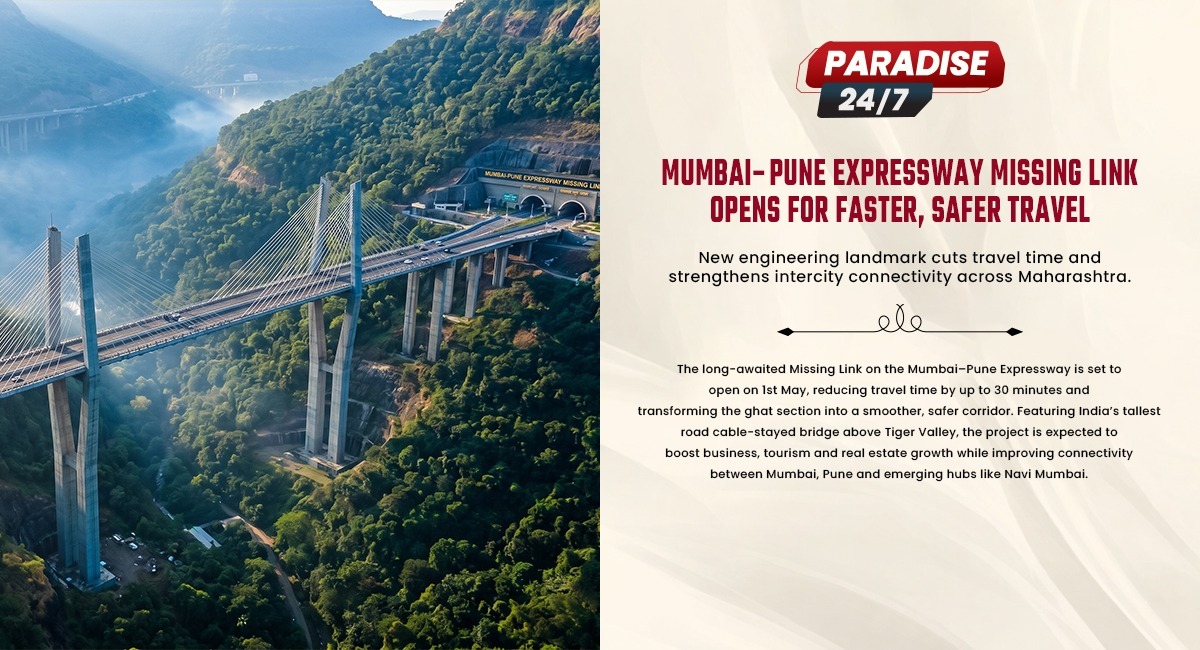
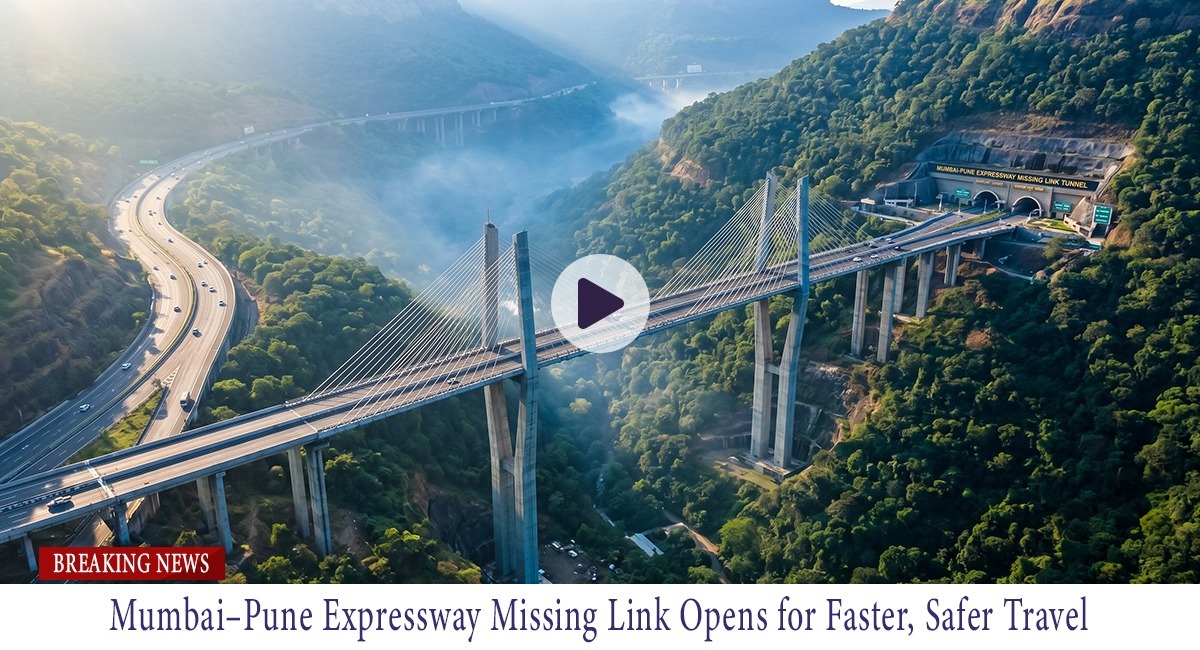
The long-awaited Missing Link of the Mumbai–Pune Expressway is finally opening, redefining how the two cities connect, commute and grow together.
The Wait Ends: Pune–Mumbai Expressway Missing Link Opens a New Chapter in Connectivity

From Long Drives to Seamless Intercity Travel

This project was designed to solve one of the most challenging stretches of the expressway — a section known for bottlenecks and steep terrain. With the new alignment in place, commuters can now expect travel time to reduce by up to 30 minutes.

What once felt like a long-distance drive will soon feel like a smooth and predictable intercity commute.

An Engineering Marvel Above Tiger Valley

At the heart of the project stands a true infrastructure landmark — India’s tallest road cable-stayed bridge, rising 182 metres above Tiger Valley.

Built across difficult terrain, this structure reflects:
  • Precision engineering
  • Complex design excellence
  • World-class safety standards
  • Future-ready infrastructure planning
It is a symbol of how modern engineering is reshaping mobility across Maharashtra.

Safer Roads. Smarter Travel.

The Missing Link focuses not just on speed, but on safety and comfort.
The upgraded route delivers:
  • Straighter road alignments
  • Reduced accident-prone zones
  • Smoother traffic flow
  • Better long-distance driving experience
Every kilometre of this corridor has been designed for the future of travel.

When Connectivity Improves, Opportunities Grow

Infrastructure upgrades do more than shorten travel time — they reshape entire growth corridors. Faster connectivity between Mumbai and Pune will boost:
  • Business and logistics movement
  • Tourism and weekend travel
  • Residential and commercial demand
  • Overall regional development
This improved connectivity strengthens the entire growth story of the Mumbai Metropolitan Region.

What This Means for Navi Mumbai Real Estate

As connectivity across Maharashtra improves, Navi Mumbai continues to emerge as one of the most strategic residential destinations. With stronger links to Mumbai, Pune and major infrastructure corridors, the city is becoming increasingly attractive for homebuyers and investors.
Leading developments by Paradise Group are perfectly positioned to benefit from this infrastructure-led growth.

Paradise Group Developments in the Growth Corridor

  • Sai World City, Sai World retreat
These projects offer modern township living, strong connectivity and future-ready lifestyle infrastructure — making them ideal for both homebuyers and long-term investors.

A Journey Designed for the Future

The opening of the Missing Link marks a new era of faster travel, stronger connections and greater opportunities.

As infrastructure continues to evolve, the Mumbai–Pune corridor is moving toward a future defined by easier commutes, stronger connectivity and endless possibilities.

FAQs

1. What is the Pune–Mumbai Expressway Missing Link project?
The Missing Link is a major infrastructure upgrade on the Mumbai–Pune Expressway designed to reduce travel time, improve road safety and enhance connectivity between Mumbai and Pune.
The new alignment is expected to reduce travel time by up to 30 minutes, making daily commuting, weekend travel and logistics movement faster and more efficient.
The project improves intercity mobility, strengthens business corridors and boosts tourism, making it one of the most significant infrastructure developments in Maharashtra.
Better connectivity increases property demand, enhances rental potential and drives long-term appreciation across nearby residential and commercial hubs.
With strong road connectivity, upcoming airport access and infrastructure upgrades, Navi Mumbai is rapidly emerging as a high-growth residential and investment hotspot.
Leading developments by Paradise Group are strategically located to benefit from improved connectivity and rising demand.

Key projects include Sai World City, Sai world retreat— offering modern township living and strong connectivity.

Infrastructure-led growth typically drives higher demand, improved lifestyle convenience and long-term price appreciation for residential projects.
With metro expansion, expressway upgrades and airport development, this is considered a strategic time for homebuyers and investors to enter the Navi Mumbai property market.
Paradise Group developments offer integrated townships, premium amenities, strong connectivity and proximity to major infrastructure projects — making them ideal for modern living and future-ready investment.

Navi Mumbai’s Innovation Era Begins: A Global Hub in the Making

Navi Mumbai’s Innovation Era Begins: A Global Hub in the Making

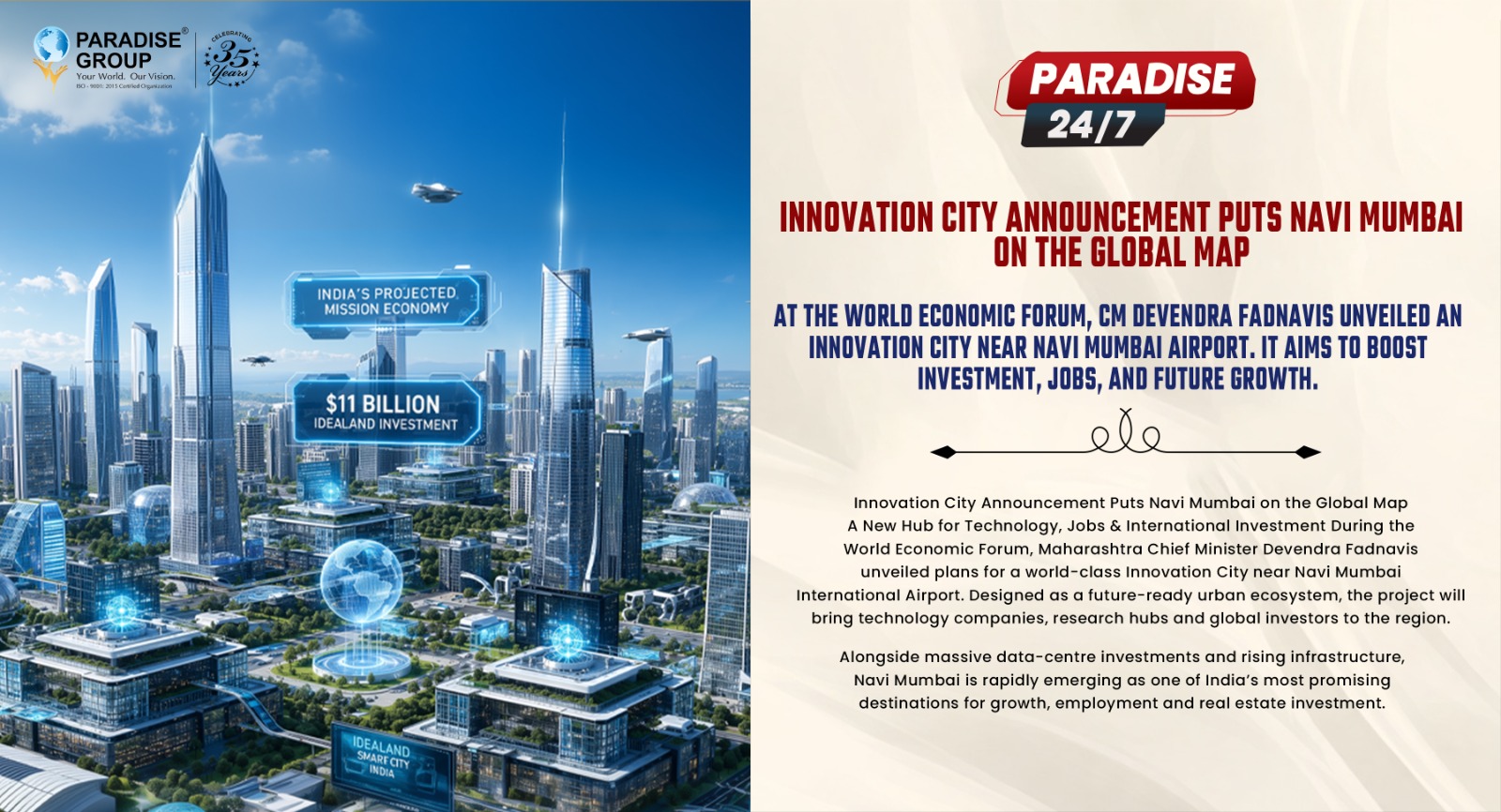
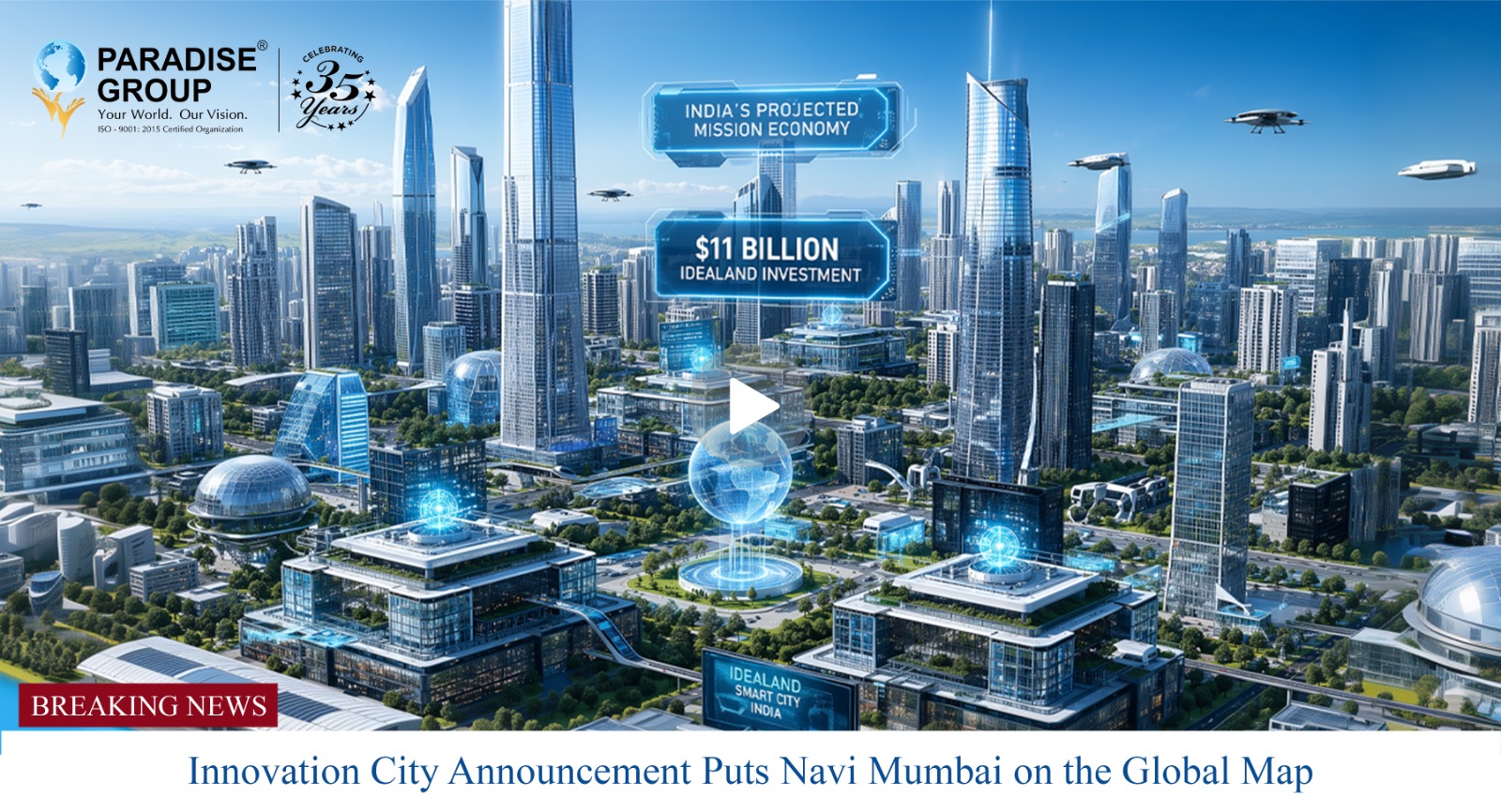
At the prestigious World Economic Forum 2026 in Davos, Switzerland, a major announcement placed Navi Mumbai firmly on the global map. Devendra Fadnavis revealed plans for a new Innovation City near Navi Mumbai International Airport, a transformative development that signals the next phase of Maharashtra’s growth story.

This announcement is not just another infrastructure update—it marks the beginning of a new economic chapter for Navi Mumbai and reinforces its emergence as India’s next global investment destination.
Navi Mumbai’s Innovation Era Begins: A Global Hub in the Making

A New Innovation City Near the Airport

The proposed Innovation City will be located just 15–20 minutes from Navi Mumbai International Airport, positioning it as a strategic hub for global business connectivity. The vision is ambitious: to build a city that connects India’s innovation ecosystem with the world.

Designed as a future-ready urban ecosystem, the Innovation City is expected to host:

  • Technology companies and startups
  • Research and development hubs
  • Global innovation centers
  • Business and entrepreneurship ecosystems

This initiative aims to transform Navi Mumbai into India’s global innovation hub, bringing together talent, technology, and international investments in one dynamic region.

$11 Billion Data Center Boom

Adding to this momentum, data centers worth $11 billion are set to come up in the region. This is a powerful indicator of Navi Mumbai’s rising role in the digital economy.

The arrival of large-scale data infrastructure will:

  • Strengthen India’s digital backbone
  • Attract global technology giants
  • Boost demand for skilled professionals
  • Position Navi Mumbai as a digital infrastructure powerhouse

This wave of digital investment will significantly accelerate economic activity and reinforce the city’s global positioning.

Jobs, Investments & Economic Acceleration

The Innovation City and data center investments are expected to generate thousands of new jobs, creating opportunities across multiple sectors including:

  • Technology & IT services
  • Logistics & aviation
  • Research & development
  • Real estate & infrastructure

As employment opportunities grow, housing demand naturally follows—driving strong momentum in the Navi Mumbai real estate market.

Why Navi Mumbai is Becoming a Top Investment Destination

With world-class infrastructure rapidly taking shape, Navi Mumbai is witnessing a powerful shift from a satellite city to a future-ready urban powerhouse.

Key growth drivers include:

  • Navi Mumbai International Airport development
  • Global innovation and tech investments
  • Data center expansion
  • Job creation and economic growth
  • Improved connectivity and infrastructure

Together, these factors are transforming Navi Mumbai into one of the most promising property investment destinations in India.

Paradise Group at the Heart of Navi Mumbai’s Growth

As the region evolves into a global hub, leading developers like Paradise Group are creating integrated lifestyle communities aligned with this growth.

Signature developments such as Sai World City, Sai Platinum, Sai Prerna, Sai Sun City, and Sai World Empire, Sai world pyramid, Sai Palm View, Sai world One are strategically positioned to benefit from Navi Mumbai’s rising connectivity, employment hubs, and infrastructure upgrades.

These communities are designed to offer modern living close to emerging business and innovation corridors—making them attractive choices for both homebuyers and long-term investors.

Buyers who act ahead of this infrastructure completion cycle historically secure the highest returns. As these projects near completion and the stadium construction commences, property prices in Navi Mumbai and its surrounding nodes are expected to rise significantly. Waiting means paying more — and earning less.

A Transformational Future for Navi Mumbai

The Innovation City announcement at Davos marks a defining moment for Maharashtra’s growth journey. With global investments, technology infrastructure, and world-class connectivity coming together, Navi Mumbai is stepping into a new era.

Navi Mumbai isn’t just growing—it’s transforming into a global innovation destination.

FAQs

1. What is the Innovation City announced at the World Economic Forum 2026?
At the World Economic Forum in Davos, Devendra Fadnavis announced a new Innovation City near Navi Mumbai International Airport. The project aims to connect India’s innovation ecosystem with global businesses, research, and technology leaders.

The Innovation City will be developed 15–20 minutes from the Navi Mumbai International Airport, making it a strategic hub for global connectivity, business expansion, and technology-driven growth.

The development is expected to generate thousands of jobs, attract global investments, and boost industries such as IT, research, startups, aviation, logistics, and real estate in Navi Mumbai.

The upcoming data centers will position Navi Mumbai as a major digital infrastructure and technology hub, strengthening India’s data ecosystem and attracting international tech companies.

Key growth drivers include:
  • Navi Mumbai International Airport
  • Innovation City development
  • Data center expansion
  • Job creation and infrastructure upgrades
These factors are increasing demand for residential and commercial properties.
Major infrastructure and employment hubs typically lead to increased housing demand, improved connectivity, and long-term property appreciation, making this a strong time to invest.
Leading developers like Paradise Group are developing integrated lifestyle communities aligned with upcoming infrastructure and business hubs.

Projects such as Sai World City, Sai Platinum, Sai Prerna, Sai Sun City, and Sai World Empire, Sai world pyramid, Sai Palm View, Sai world One are positioned to benefit from the region’s connectivity, employment opportunities, and future infrastructure.

Yes. With global investments, innovation hubs, and large-scale infrastructure projects underway, Navi Mumbai is considered one of India’s most promising long-term property investment markets.
The combination of airport connectivity, Innovation City, data centers, and global investments is transforming Navi Mumbai into a future-ready city focused on technology, entrepreneurship, and international business growth.

FedEx Announces ₹2,500 Crore Automated Cargo Hub at Navi Mumbai International Airport

FedEx Announces ₹2,500 Crore Automated Cargo Hub at Navi Mumbai International Airport

The growth momentum of Navi Mumbai has received a major boost as global logistics leader FedEx announces a landmark investment that will reshape the region’s global trade and infrastructure landscape.

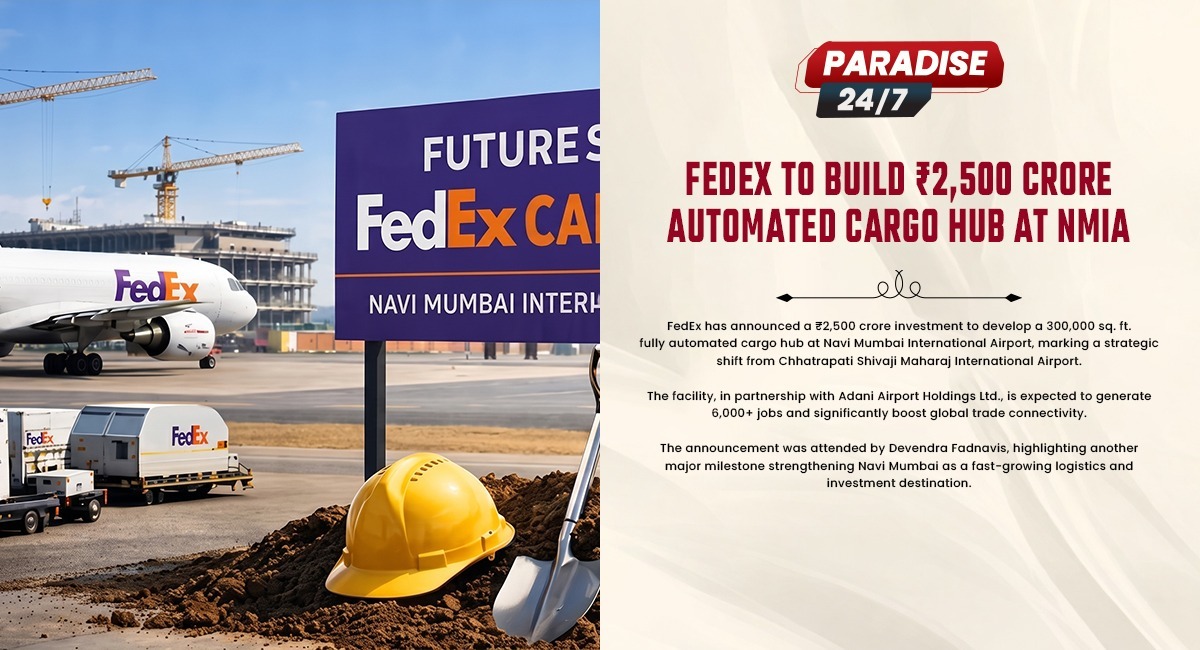
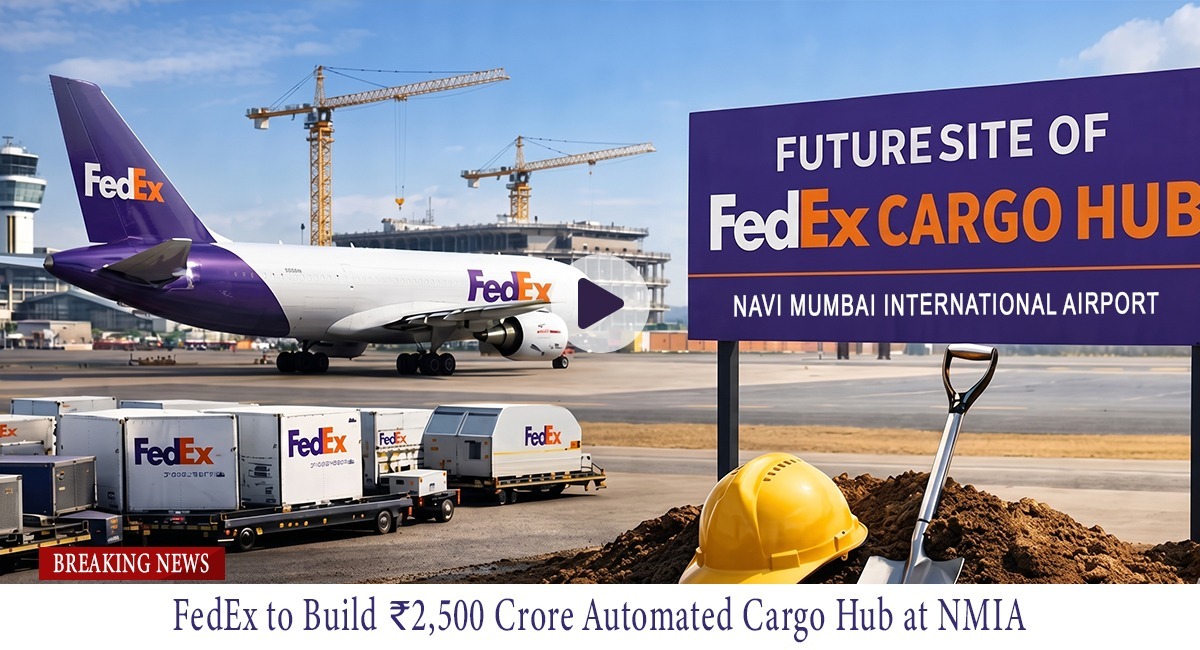
The company has unveiled plans to set up a ₹2,500 crore automated cargo hub at Navi Mumbai International Airport, marking a strategic transition of cargo operations from Chhatrapati Shivaji Maharaj International Airport.

A Strategic Move Strengthening Global Connectivity

The upcoming 300,000 sq. ft. fully automated cargo facility will be developed in partnership with Adani Airport Holdings Ltd.. This advanced logistics hub is expected to significantly improve cargo efficiency, reduce transit timelines, and strengthen India’s role in global supply chains.

The announcement ceremony was attended by Devendra Fadnavis, highlighting the project’s importance as a milestone infrastructure development for Maharashtra.

Employment, Infrastructure & Economic Expansion

The project is expected to create over 6,000 jobs, triggering growth across logistics, warehousing, aviation, and supporting industries. Large-scale global investments like this typically act as economic multipliers—accelerating infrastructure development and increasing housing demand in surrounding regions.

As a result, Navi Mumbai is fast emerging as India’s next major logistics and business destination.

Infrastructure Growth Driving Real Estate Demand

With global infrastructure projects taking shape, real estate demand in Navi Mumbai is witnessing a strong upward trajectory. Improved connectivity, employment hubs, and international investment are creating new opportunities for both homebuyers and investors seeking long-term value.

At the centre of this transformation is Paradise Group, developing integrated lifestyle communities aligned with the city’s future growth.

Paradise Group continues to shape Navi Mumbai’s residential landscape through its landmark developments including:

Sai World City, Sai Platinum, Sai Prerna, Sai Sun City, and Sai World Empire, Sai world pyramid, Sai Palm View, Sai world One These developments are strategically positioned to benefit from the region’s rapidly improving infrastructure, connectivity, and rising investment potential.

Navi Mumbai’s Growth Story Gets Stronger

The FedEx cargo hub is more than just an infrastructure announcement—it signals the beginning of a new growth chapter for Navi Mumbai. With global connectivity, job creation, and world-class infrastructure coming together, the region is steadily transforming into one of India’s most compelling real estate and investment destinations.

Why Now is the Right Time to Invest in Navi Mumbai

Infrastructure projects of this magnitude do not arrive alone. The proposed 1-lakh-seater stadium is part of a wider ecosystem of development that includes the Navi Mumbai International Airport, Metro Line 8 (Mumbai to Navi Mumbai), the Atal Setu Trans Harbour Link, expanded road networks, and a growing social infrastructure of schools, hospitals, malls, and tech parks.
Buyers who act ahead of this infrastructure completion cycle historically secure the highest returns. As these projects near completion and the stadium construction commences, property prices in Navi Mumbai and its surrounding nodes are expected to rise significantly. Waiting means paying more — and earning less.

FAQs

1. What is the new FedEx project in Navi Mumbai?
FedEx has announced a ₹2,500 crore fully automated cargo hub at Navi Mumbai International Airport. The 300,000 sq. ft. facility will strengthen global trade connectivity and make the region a major logistics gateway.
The cargo operations are transitioning from Chhatrapati Shivaji Maharaj International Airport to the new airport to support future expansion, higher cargo capacity, and advanced automation infrastructure.

The cargo hub is expected to create over 6,000 jobs and generate demand across logistics, warehousing, aviation, retail, and real estate sectors in Navi Mumbai.

The announcement ceremony was attended by Devendra Fadnavis, marking the cargo hub as a major milestone in Maharashtra’s infrastructure and economic growth story.
Large infrastructure investments typically increase housing demand, improve connectivity, and drive long-term property appreciation—making Navi Mumbai a strong real estate investment destination.
Key reasons include:
  • Navi Mumbai International Airport development
  • Growing logistics and business hubs
  • Job creation and economic growth
  • Improved connectivity and infrastructure
These factors are driving strong interest from homebuyers and investors.
Developers like Paradise Group are developing integrated lifestyle communities aligned with upcoming infrastructure and employment hubs.

Projects such as Sai World City, Sai Platinum, Sai Prerna, Sai Sun City, and Sai World Empire are strategically positioned to benefit from the region’s connectivity, infrastructure upgrades, and rising investment potential.

With global investments, airport development, and job creation underway, many experts consider this an ideal time for long-term property investment in Navi Mumbai.

The automated logistics facility will reduce cargo transit times, increase capacity, and connect Navi Mumbai more efficiently with global markets—strengthening India’s trade ecosystem.

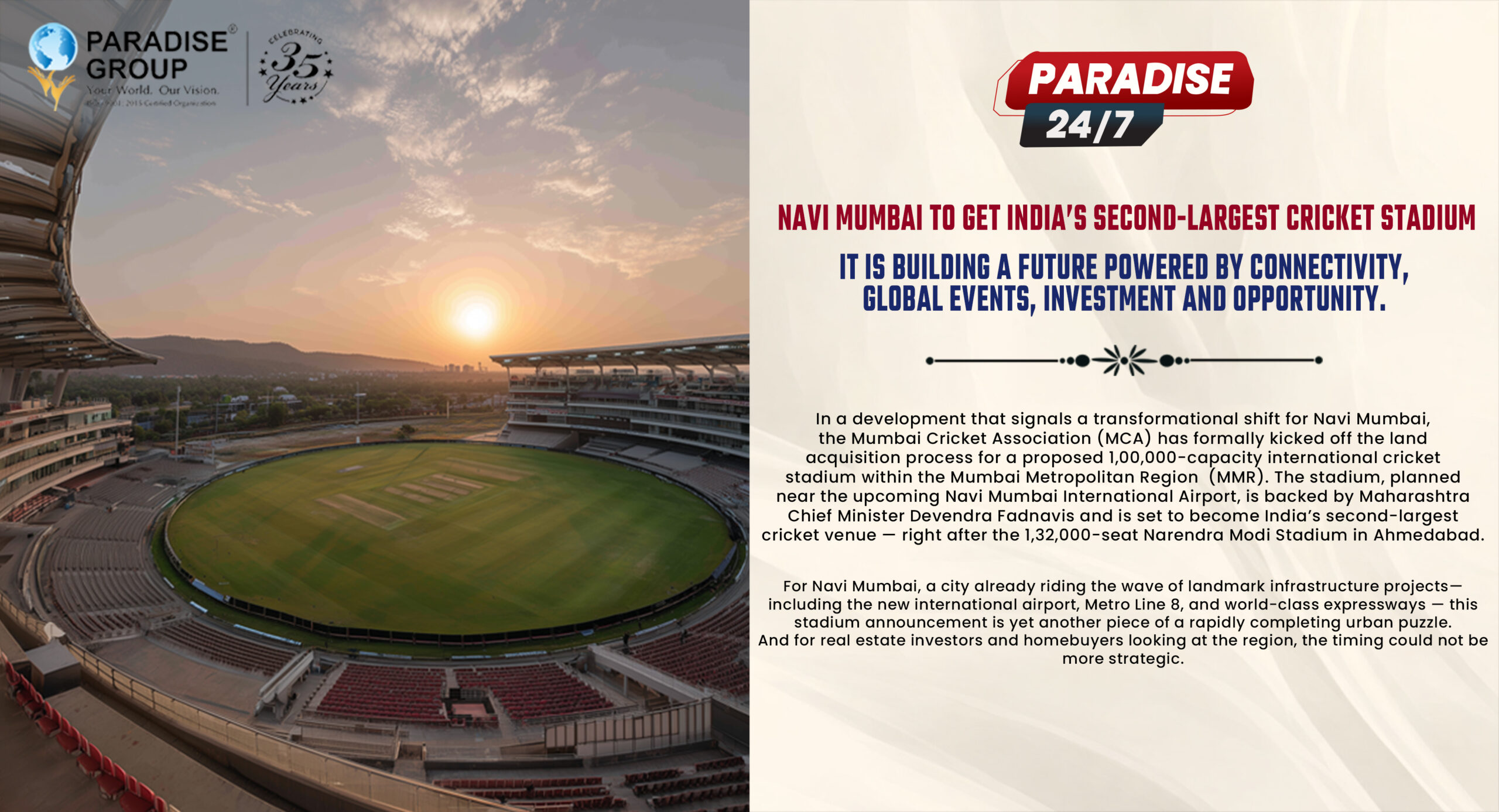
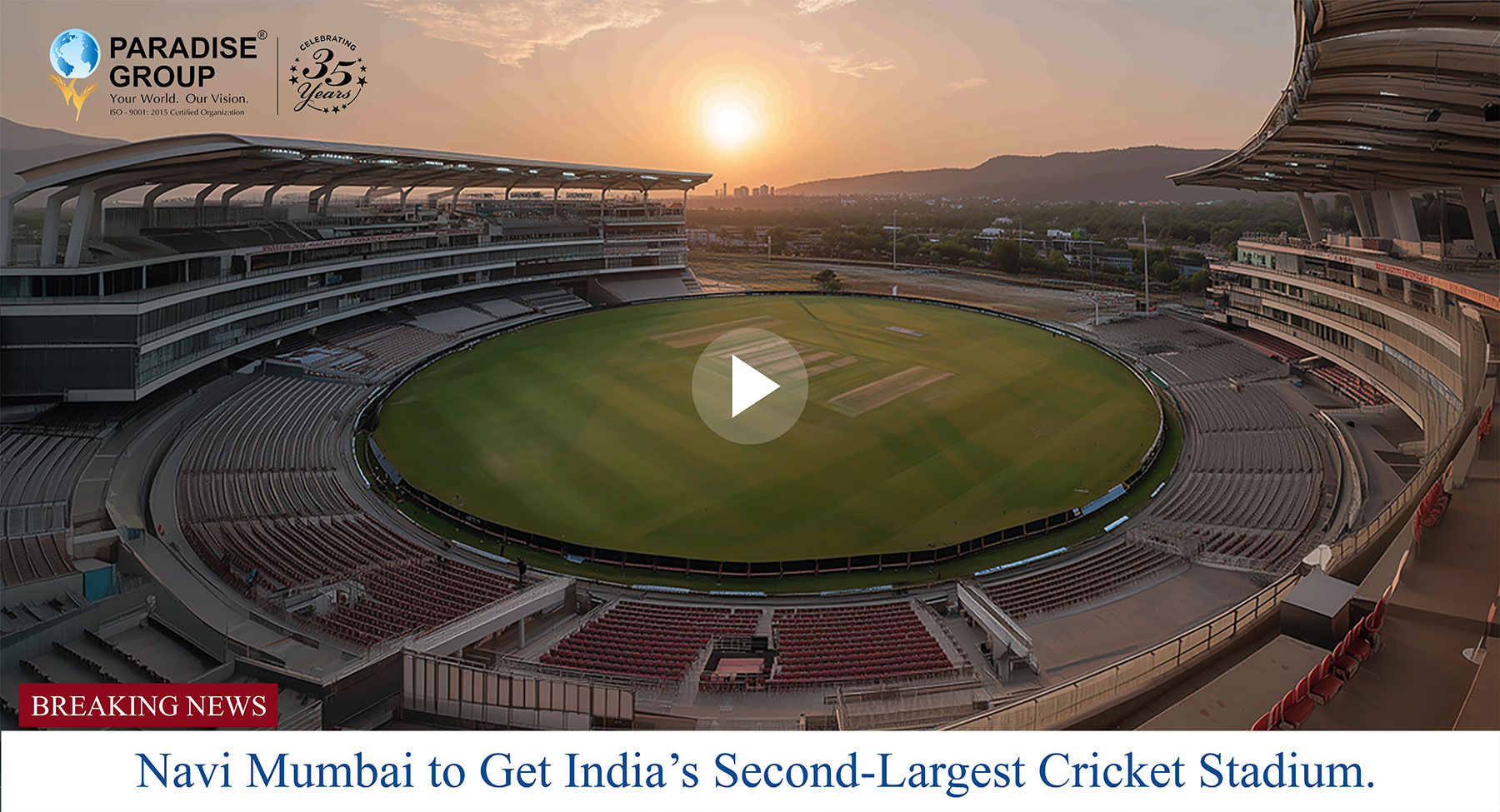
Navi Mumbai to Get India’s Second-Largest Cricket Stadium: A 1 Lakh-Seater International Venue That Will Transform the Mumbai Metropolitan Region

Navi Mumbai to Get India’s Second-Largest Cricket Stadium: A 1 Lakh-Seater International Venue That Will Transform the Mumbai Metropolitan Region

Mumbai Cricket Association initiates land acquisition with CIDCO near the Navi Mumbai International Airport; Maharashtra CM Devendra Fadnavis backs the mega-project that promises global recognition — and a massive real estate boost.

In a development that signals a transformational shift for Navi Mumbai, the Mumbai Cricket Association (MCA) has formally kicked off the land acquisition process for a proposed 1,00,000-capacity international cricket stadium within the Mumbai Metropolitan Region (MMR). The stadium, planned near the upcoming Navi Mumbai International Airport, is backed by Maharashtra Chief Minister Devendra Fadnavis and is set to become India’s second-largest cricket venue — right after the 1,32,000-seat Narendra Modi Stadium in Ahmedabad.

For Navi Mumbai, a city already riding the wave of landmark infrastructure projects — including the new international airport, Metro Line 8, and world-class expressways — this stadium announcement is yet another piece of a rapidly completing urban puzzle. And for real estate investors and homebuyers looking at the region, the timing could not be more strategic.

The Big News: What is the Navi Mumbai Cricket Stadium Project?

The Mumbai Cricket Association (MCA), under president Ajinkya Naik, has initiated formal discussions with the City and Industrial Development Corporation of Maharashtra Ltd (CIDCO) to secure a land parcel in Navi Mumbai for the proposed stadium. MCA president Naik met CIDCO Managing Director Vijay Singhal to chart the roadmap for what is expected to become one of the largest cricket stadiums in the world.

Key project highlights include:

  • Proposed seating capacity: 1,00,000 spectators
  • Location: Near the Navi Mumbai International Airport (Ulwe/MMR belt)
  • Government backing: Maharashtra CM Devendra Fadnavis pledged land support in May 2025
  • Land size: Approximately 50 acres
  • Status: Land acquisition process initiated; state cabinet clearance pending
  • Construction to begin: Approximately 6 months after land allotment approval

Once built, the stadium will surpass the iconic Eden Gardens in Kolkata (68,000 seats) and the DY Patil Stadium in Navi Mumbai (46,000 seats) in capacity, making it a truly world-class venue for India.

Why Navi Mumbai? The Location Advantage

The decision to site this mega-stadium near the Navi Mumbai International Airport is no coincidence. Navi Mumbai is fast emerging as one of the most strategically planned urban zones in India. With multiple infrastructure initiatives converging — metro corridors, highway upgrades, a new international airport, and now a world-class cricket stadium — the region is poised to become a global city in its own right.

The location advantages are clear:

  • Direct airport connectivity makes it accessible for international cricket tours, players, and sports tourists
  • Metro Line 8, connecting Mumbai’s Chhatrapati Shivaji Maharaj International Airport to Navi Mumbai Airport, will pass through key nodes like Kharghar, Nerul, and Panvel
  • The Navi Mumbai-Mumbai Trans Harbour Link (Atal Setu) further cuts down travel time between South Mumbai and Navi Mumbai
  • The region already has established sporting infrastructure via the DY Patil Stadium, which hosted the 2025 Women’s ODI World Cup semifinal and final

As MCA president Naik stated, a cricket stadium near the Navi Mumbai airport will be convenient for all — fans, players, officials, and broadcasters alike.

Maharashtra CM Devendra Fadnavis: The Vision Behind the Stadium

The project owes its momentum to Maharashtra Chief Minister Devendra Fadnavis, who in May 2025 publicly committed to allotting government land to the MCA for a 1-lakh-capacity stadium. At the inauguration of new stands at Wankhede Stadium — named after Ajit Wadekar, Rohit Sharma, and Sharad Pawar — Fadnavis assured the cricketing fraternity that Navi Mumbai would house a venue befitting the city’s stature.

MCA president Naik has since met Fadnavis to push for faster clearances and is now working directly with CIDCO to ensure the land allotment moves swiftly through state cabinet approval. The vision is clear: position Maharashtra as a permanent destination on the global sporting calendar.

India’s Cricket Stadium Rankings — Where Will Navi Mumbai Stand?

Once completed, the Navi Mumbai stadium will reorder India’s cricketing geography:

  • 1st — Narendra Modi Stadium, Ahmedabad: 1,32,000 seats
  • 2nd — Proposed Navi Mumbai International Cricket Stadium: 1,00,000 seats
  • 3rd — Eden Gardens, Kolkata: 68,000 seats
  • 4th — DY Patil Stadium, Navi Mumbai: 46,000 seats
  • 5th — Wankhede Stadium, Mumbai: 33,108 seats

Mumbai has long punched below its weight in terms of cricket seating capacity relative to its population and passion for the sport. The new stadium is the answer to that long-standing gap.

What This Means for Navi Mumbai Real Estate

Infrastructure and real estate are inseparable. Every time a major civic project is announced in or near a residential micro-market, property values in that zone experience measurable appreciation. The Navi Mumbai cricket stadium announcement adds yet another powerful catalyst to a region already supercharged with infrastructure momentum.
1. Surge in Demand for Residential Properties
A 1-lakh-seater stadium will attract thousands of cricket fans, sports tourists, broadcasters, sponsors, and officials to the region on a regular basis. This demand drives up the need for hotels, serviced apartments, and residential housing in surrounding areas. Kharghar, Nerul, Panvel, and Upper Kharghar — the emerging residential corridors of Navi Mumbai — stand to benefit most directly.
2. Rise in Commercial and Retail Activity
Stadiums of this scale are catalysts for commercial real estate. Food and beverage, sports retail, hospitality, and entertainment zones typically spring up around large venues. The stadium’s location near the Navi Mumbai International Airport further amplifies this commercial pull.
3. Property Appreciation Across the MMR Belt
Proximity to sports infrastructure has historically driven property value appreciation in global cities. With this stadium combining airport adjacency, metro connectivity, and international-grade sporting infrastructure, properties in the Navi Mumbai-Panvel-Kharghar corridor are positioned for strong long-term appreciation.

Paradise Group Projects: Perfectly Positioned to Benefit

With a 35-year legacy of delivering landmark residential projects across Navi Mumbai’s highest-growth corridors, Paradise Group stands at the intersection of every major infrastructure story unfolding in the MMR. Here is how Paradise Group’s key projects align with the stadium’s real estate impact:
Sai World Empire — Kharghar
Located in Navi Mumbai’s fastest-growing node, Sai World Empire will benefit from the combined boost of Metro Line 8 connectivity and the new stadium’s economic halo effect. Kharghar’s proximity to key transport corridors and its established social infrastructure make it one of the most sought-after residential destinations in MMR.
Sai World One — Nerul
Offering premium lifestyle residences and commercial office spaces, Sai World One in Nerul is directly in the path of the stadium’s connectivity-driven uplift. Nerul is one of the nodal stops on Metro Line 8 and sits well within the stadium’s catchment zone, making it ideal for professionals and investors.
Sai World Pyramid — Nerul
Positioned in one of Navi Mumbai’s most dynamically developing micro-markets, Sai World Pyramid stands to gain from rising demand as Nerul transforms into a key sports and commercial hub alongside the new stadium development.
Sai Palm View — Nerul, Palm Beach Road
An ultra-premium residential development on Palm Beach Road, Sai Palm View combines aspirational living with exceptional connectivity. As the stadium drives footfall and economic activity across the Palm Beach Road corridor, this address will only grow in stature and value.
Sai World City — Panvel
This premium self-sustained township in Panvel is strategically placed near the Navi Mumbai International Airport and the proposed stadium corridor. For buyers seeking a future-ready, integrated living environment, Sai World City represents a compelling long-term investment.
Sai Sun City — Upper Kharghar
With direct benefits from infrastructure growth in the Kharghar-Panvel belt, Sai Sun City offers homebuyers the twin advantages of connectivity and appreciation potential, especially as the stadium and airport development gather pace.
Sai World Dreams — Dombivli
Shilphata Corridor While slightly further from the stadium site, Sai World Dreams benefits from the broader infrastructure wave sweeping the MMR. The Kalyan-Dombivli belt’s rapid development — driven by road and metro networks — makes this project an attractive option for buyers seeking affordability with growth potential.
Sai Platinum — Kharghar
Offering comfort, connectivity, and strong appreciation prospects, Sai Platinum in Kharghar is well-placed to capture demand from families and first-time homebuyers drawn to Navi Mumbai’s evolving urban landscape.

Why Now is the Right Time to Invest in Navi Mumbai

Infrastructure projects of this magnitude do not arrive alone. The proposed 1-lakh-seater stadium is part of a wider ecosystem of development that includes the Navi Mumbai International Airport, Metro Line 8 (Mumbai to Navi Mumbai), the Atal Setu Trans Harbour Link, expanded road networks, and a growing social infrastructure of schools, hospitals, malls, and tech parks.
Buyers who act ahead of this infrastructure completion cycle historically secure the highest returns. As these projects near completion and the stadium construction commences, property prices in Navi Mumbai and its surrounding nodes are expected to rise significantly. Waiting means paying more — and earning less.

Conclusion: A New Era for Navi Mumbai — and for Real Estate

The proposed 1 lakh-seater international cricket stadium in Navi Mumbai is not just a sporting milestone. It is a statement of intent from the Maharashtra government that Navi Mumbai is ready to take its place among the great urban centres of the world. Combined with the new international airport, metro connectivity, and a thriving residential ecosystem, Navi Mumbai is entering a golden phase of growth.
For Paradise Group, this is the story they have been building towards for 35 years — placing world-class homes in locations where infrastructure, opportunity, and lifestyle converge. The question is not whether Navi Mumbai will grow. The question is whether you will be part of that growth.

FAQ’s

1. What is the proposed cricket stadium in Navi Mumbai?
The Mumbai Cricket Association (MCA) has initiated the process to build a 1,00,000-seat international cricket stadium in Navi Mumbai, near the upcoming Navi Mumbai International Airport. It is backed by Maharashtra Chief Minister Devendra Fadnavis and will be developed in partnership with CIDCO.
The Mumbai Cricket Association (MCA), led by president Ajinkya Naik, is building the stadium. The project has state government support and is being coordinated with CIDCO (City and Industrial Development Corporation of Maharashtra) for land allotment.
The proposed stadium will be located in the Navi Mumbai area, near the upcoming Navi Mumbai International Airport. Earlier, a site in Aamne near Thane (26 km off Thane) was also under consideration. The final site is expected to be confirmed after state cabinet clearance.
The proposed stadium will have a seating capacity of 1,00,000 spectators, making it India’s second-largest cricket venue after the Narendra Modi Stadium in Ahmedabad, which has a capacity of approximately 1,32,000.
Construction is expected to begin approximately six months after state cabinet clearance and land allotment are completed. As of April 2026, the land acquisition process has been formally initiated. No official construction timeline has been announced yet.
Large-scale sports infrastructure projects historically drive up property demand and prices in surrounding areas. The stadium, combined with the upcoming Navi Mumbai International Airport and Metro Line 8, is expected to significantly boost residential and commercial property values across Kharghar, Nerul, Panvel, and the broader MMR belt.
Yes, once the stadium is complete, Navi Mumbai is expected to host international cricket matches including Tests, ODIs, T20Is, and potentially ICC tournaments such as the Cricket World Cup. Officials have stated the aim is to attract major global cricket events to Maharashtra.
The DY Patil Stadium in Navi Mumbai, which hosted the 2025 Women’s ODI World Cup semifinal and final, has a capacity of approximately 46,000 seats. The new MCA stadium, at 1,00,000 seats, will be more than double its capacity and publicly owned, unlike the DY Patil Stadium which is privately operated.
Projects with the most direct proximity to the stadium corridor and supporting infrastructure include Paradise Sai World Empire (Kharghar), Sai World One (Nerul), Sai World Pyramid (Nerul), Sai Palm View (Palm Beach Road, Nerul), Paradise Sai World City (Panvel), Sai Sun City (Upper Kharghar), and Sai Platinum (Kharghar).
Yes, real estate experts consider the current period an ideal time to invest in Navi Mumbai, as buyers stand to benefit from pre-completion pricing ahead of major infrastructure delivery. The convergence of the new international airport, Metro Line 8, Atal Setu Trans Harbour Link, and the proposed cricket stadium creates a uniquely powerful appreciation environment.
CIDCO (City and Industrial Development Corporation of Maharashtra) is the government body responsible for the planned development of Navi Mumbai. It controls large land parcels in the region and is the key agency from which the MCA is seeking a land allotment for the stadium. CIDCO MD Vijay Singhal has already held detailed discussions with MCA president Ajinkya Naik on the project roadmap.
Mumbai currently relies on the Wankhede Stadium as its primary international cricket venue, with a capacity of 33,108 spectators. Given Mumbai’s population and the enormous demand for match tickets, the Wankhede Stadium has long been considered insufficient. The new Navi Mumbai stadium is designed to bridge this gap decisively.

Insights on Redevelopment & MIDC Growth by our MD Mr. Manish Bathija on News18 Marathi

Insights on Redevelopment & MIDC Growth by our MD Mr. Manish Bathija on News18 Marathi

The real estate sector in Maharashtra is undergoing a significant transformation, driven by rapid urbanization, infrastructure upgrades, and evolving buyer expectations. Recently, our Managing Director, Mr. Manish Bathija, was invited as a distinguished speaker on a live talk show hosted by News18 Marathi, where he shared valuable insights on two of the most impactful trends shaping the industry today—redevelopment and MIDC-led growth.

Redevelopment: Transforming Urban Living

During the discussion, Mr. Bathija highlighted how redevelopment is no longer just an option but a necessity in cities facing space constraints and aging infrastructure. He emphasized that redevelopment projects are:
  • Revitalizing old housing societies into modern, safe, and sustainable living spaces
  • Enhancing property value for existing residents
  • Improving overall urban infrastructure and lifestyle standards
He also noted that with increasing awareness among homeowners, transparency and trust have become key factors in successful redevelopment projects. Developers today are expected to deliver not just homes, but complete lifestyle upgrades.

MIDC Development: Driving Economic Expansion

Another key topic of the discussion was the development of MIDC area in boosting regional growth through Real Estate Development. Mr. Bathija explained how MIDC zones’ development are:
  • Creating employment opportunities across multiple sectors due to reservation in making commercial spaces
  • Attracting businesses and big corporates to these emerging locations
  • Over-all increase in demand for residential and commercial real estate
  • Shifting city adjacent MIDC corporations to newer allotted MIDC areas and allocating them for commercial and residential development
He further elaborated that areas with these MIDC development hubs are witnessing rapid development, making them attractive investment destinations for both homebuyers and investors.

The Developer’s Role in Future Growth

Mr. Bathija emphasized that modern real estate developers play a crucial role in shaping the future of cities. Beyond construction, developers are now responsible for:
  • Sustainable and eco-friendly development practices
  • Delivering quality infrastructure
  • Creating integrated communities with lifestyle amenities
He also stressed the importance of aligning development with long-term urban planning to ensure balanced growth.

A Vision for Tomorrow

The discussion concluded with a forward-looking perspective on Maharashtra’s real estate landscape. With ongoing infrastructure projects, redevelopment initiatives, and MIDC development, the sector is poised for steady and sustainable growth.

FAQ’s

1. What is redevelopment in real estate?

Redevelopment is the process of reconstructing old or unsafe buildings into modern residential or commercial projects with improved amenities, better safety standards, and enhanced lifestyle features.

With limited land availability and aging infrastructure in cities, redevelopment helps optimize existing land, upgrade living conditions, and meet the growing demand for modern housing.

Maharashtra Industrial Development Corporation (MIDC) was originally established to develop industrial zones. However, many MIDC areas located near cities are now being integrated into urban development plans due to their strategic location and connectivity.

MIDC areas close to cities are now being redeveloped and permitted for residential and commercial use. This transformation is:

  • Expanding city boundaries
  • Creating new real estate hubs

Increasing demand for housing and business spaces

Due to their proximity to urban centers, existing infrastructure, and improved connectivity, these areas are naturally evolving into extensions of the city, making them highly attractive for development and investment.

Yes, in many cases, MIDC lands near cities are being re-planned or re-designated, allowing developers to build residential and commercial projects, depending on government approvals and urban development policies.

Investing in such areas offers:

  • Early entry into developing city zones
  • High potential for price appreciation
  • Improved infrastructure and connectivity
  • Growing demand for residential and commercial spaces
  • Redevelopment focuses on rebuilding existing residential societies within the city
  • MIDC-led development involves transforming industrial zones near cities into mixed-use developments (residential + commercial)
  • Developers play a key role in converting these areas into livable and business-friendly zones by planning modern infrastructure, residential complexes, and commercial hubs aligned with urban growth.

  • MIDC areas located near cities are expected to become integral parts of urban expansion, supporting residential demand, commercial growth, and overall city development in the coming years.

Yes, such transformations are typically guided by urban planning policies and government approvals, ensuring structured and sustainable development of these areas.

The paradise group has introduced a redevelopment project at Palm Beach Road—Sai Palm View—along with two mixed-use projects at prime locations opposite DY Patil Stadium and in the KTLR for MIDC led development, named Sai World One and Sai World Pyramid.

The Future of Real Estate in Dombivli and Kalyan

The Future of Real Estate in Dombivli and Kalyan: Thane Bullet Train Station and BKC-Inspired Business Hub

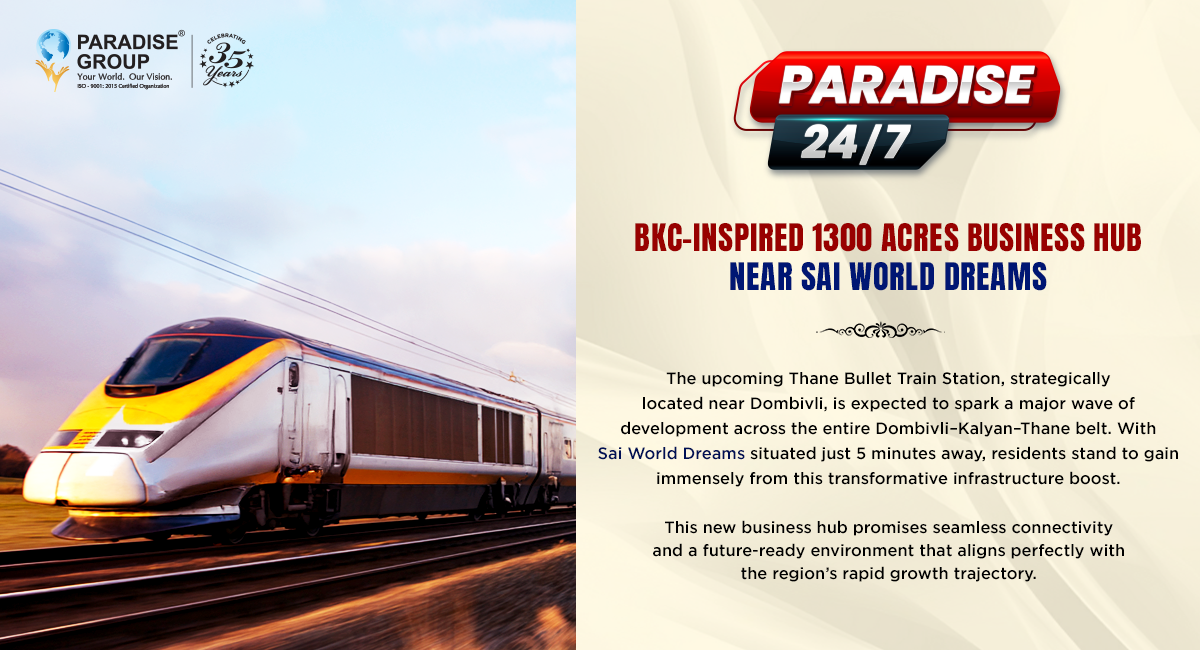
The Thane Bullet Train Station is poised to be one of the most significant developments in Mumbai’s suburban landscape, and it’s bringing about a wave of change in Dombivli and Kalyan. This major infrastructural project will not only improve connectivity but also serve as a catalyst for rapid real estate growth in these emerging regions. For Paradise Group, this new development offers exciting possibilities for our flagship residential projects: Sai World Dreams in Dombivli and Sai World Legend in Kalyan.

In addition to the Thane Bullet Train Station, another significant project is a 1300 sq. ft. business hub inspired by BKC, being developed near Sai World Dreams in Dombivli. This commercial space, inspired by the bustling Bandra-Kurla Complex (BKC) in Mumbai, is set to transform Dombivli into a major business hub. This exciting addition will elevate the area, making it a sought-after destination for both residents and businesses.

The Thane Bullet Train Station: A Game-Changer for Dombivli and Kalyan

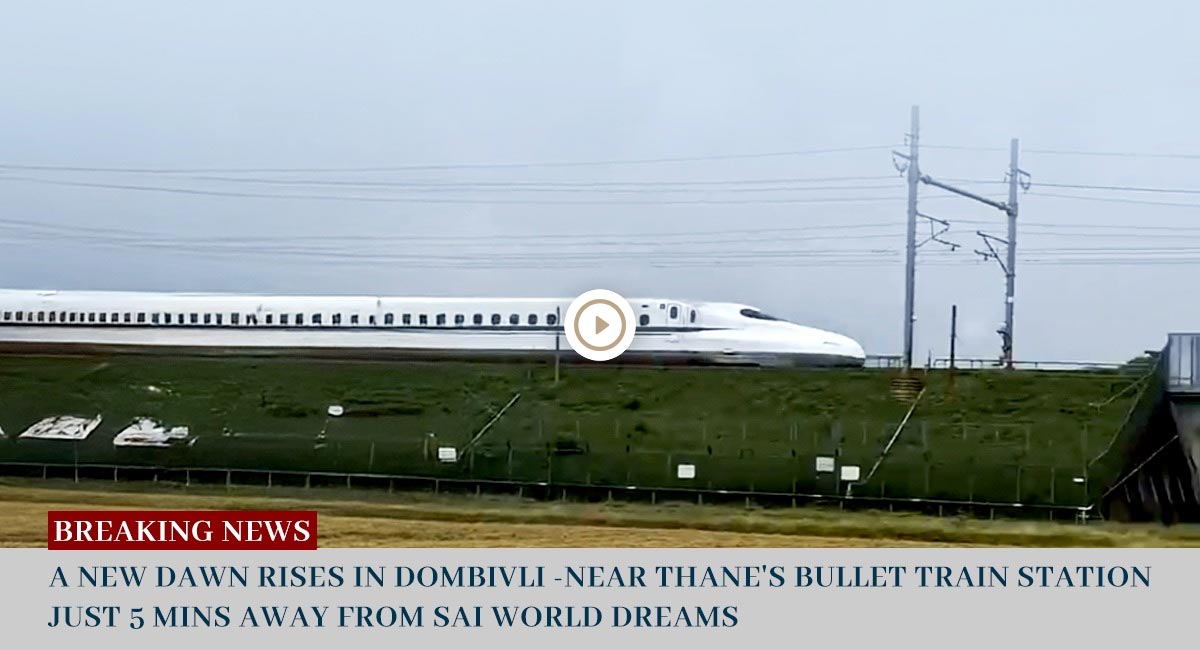
The Thane Bullet Train Station, strategically located near Sai World Dreams, is expected to drastically reduce travel time between Dombivli, Kalyan, and Mumbai’s central business districts. Residents of Sai World Dreams in Dombivli will be just 5 minutes away from this game-changing infrastructure, enhancing connectivity and providing easier access to key commercial zones in Mumbai.

Similarly, Sai World Legend in Kalyan, with its prime location and access to the Bullet Train Station, will experience a surge in demand. The improved connectivity will make this area even more attractive for both homebuyers and commercial investors.

The BKC-Inspired 1300 Sq. Ft. Business Hub: Elevating Dombivli’s Commercial Landscape

Adding to the excitement is the BKC-inspired 1300 sq. ft. business hub coming up near Sai World Dreams in Dombivli. This business hub, designed to offer a modern, professional environment, will attract businesses and entrepreneurs seeking to establish operations in a prime location. The proximity to the Bullet Train Station ensures that this business hub will be easily accessible for professionals commuting to Mumbai, while also offering a strategic location for businesses looking to tap into the rapidly growing Dombivli-Kalyan-Thane belt.

For Sai World Dreams, the presence of this commercial space adds immense value to the project. Residents of Sai World Dreams will enjoy the convenience of having modern office spaces, retail outlets, and dining options just a stone’s throw away. The 1300 sq. ft. business hub brings the best of both worlds: affordable, premium living spaces combined with top-tier commercial facilities.

Why Dombivli and Kalyan Are Set for Rapid Growth

The combination of the Thane Bullet Train Station, the BKC-inspired business hub, and the flourishing real estate market in Dombivli and Kalyan makes these areas the next big thing in Mumbai’s suburban real estate landscape. The ease of commuting from Dombivli and Kalyan to Mumbai will significantly increase demand for residential properties such as 2 BHK flats in Kalyan West, 3 BHK flats in Kalyan, and 1 BHK flats in Dombivli.

In Sai World Legend in Kalyan, the arrival of the Bullet Train Station, coupled with the development of a nearby commercial hub, will undoubtedly boost the area’s appeal. Investors and homebuyers looking for luxury flats in Kalyan, or even affordable 1 BHKs, will find this area increasingly attractive.

Sai World Dreams and Sai World Legend: The Future of Luxury Living

At Paradise Group, we believe in building homes that offer the perfect combination of luxury and practicality. Both Sai World Dreams and Sai World Legend are designed with this vision in mind.

Sai World Dreams, located in the heart of Dombivli, offers beautifully crafted 2 and 3 BHK flats with modern amenities. With the BKC-inspired 1300 sq. ft. business hub right next door, residents can enjoy a balanced lifestyle that combines professional convenience with the comforts of home.

Sai World Legend, located in Kalyan, takes luxury living to a whole new level. Whether you’re looking for 2 BHK flats in Kalyan East, 3 BHK flats, or premium living spaces for your family, this project offers spacious homes designed to meet all your needs. With the Bullet Train Station nearby, you’ll have easy access to both the best of Mumbai and the peace and serenity of suburban life.

Real Estate Investment in Dombivli and Kalyan: A Smart Move

The development of the Thane Bullet Train Station and the BKC-inspired business hub makes this the perfect time to invest in real estate in Dombivli and Kalyan. With the upcoming infrastructure projects, properties in these areas are set to see a sharp increase in value. Whether you’re interested in buying affordable flats in Dombivli, 2 BHK flats in Kalyan West, or luxury homes in Kalyan, now is the time to invest in the future.

Both Sai World Dreams and Sai World Legend offer unmatched opportunities for investors seeking to tap into the growth potential of these rapidly developing regions. With world-class infrastructure, excellent connectivity, and a prime location, these projects promise not only a high quality of life but also a sound investment for the future.

Conclusion: A Bright Future for Dombivli and Kalyan

The introduction of the Thane Bullet Train Station and the development of the BKC-inspired 1300 sq. ft. business hub are just the beginning of a new chapter for Dombivli and Kalyan. These areas are set to emerge as key business and residential hubs in the coming years. For Paradise Group, this is an exciting time, as our Sai World Dreams and Sai World Legends projects are perfectly positioned to benefit from these transformative developments.

Whether you’re looking for a 2 BHK flat in Kalyan West, 1 BHK flats in Dombivli, or luxury living spaces, Paradise Group offers a range of options to meet your needs. Now is the time to invest in these growing communities and be a part of the next wave of development in Dombivli and Kalyan.

FAQ’s

1. How will the Thane Bullet Train Station impact real estate in Dombivli and Kalyan?

The Thane Bullet Train Station, located near Sai World Dreams in Dombivli, will significantly enhance connectivity to Mumbai’s central business districts, reducing commute times. This improved transportation link will boost demand for residential properties in Dombivli and Kalyan, making the area an attractive location for homebuyers and investors. With the upcoming BKC-inspired 1300 sq. ft. business hub in Dombivli, these areas are set to become prime real estate destinations in the Mumbai metropolitan region.

Sai World Dreams in Dombivli offers a variety of residential options, including 2 and 3 BHK flats, designed for comfort and luxury. The project is strategically located near the Thane Bullet Train Station, ensuring easy access to Mumbai and nearby commercial hubs. Residents will enjoy modern amenities, green spaces, and a tranquil living environment, all within a vibrant and rapidly developing community.

The BKC-inspired 1300 sq. ft. business hub is an upcoming commercial development located near Sai World Dreams in Dombivli. Inspired by Mumbai’s Bandra-Kurla Complex (BKC), this business hub will provide a professional environment with modern office spaces, retail outlets, and dining options. It will offer great opportunities for businesses and entrepreneurs, making the area even more attractive for residents and investors.

Sai World Legend in Kalyan is located near the upcoming Thane Bullet Train Station, offering residents easy access to Mumbai’s business districts in a matter of minutes. This improved connectivity will make Kalyan a prime location for homebuyers seeking affordable yet well-connected homes. With luxury 2 BHK flats and spacious 3 BHK flats, Sai World Legend offers a perfect balance of comfort and convenience, making it a great choice for families and professionals.

Yes, now is an excellent time to invest in real estate in Dombivli and Kalyan. The development of the Thane Bullet Train Station and the BKC-inspired 1300 sq. ft. business hub is expected to drive significant growth in the region. These infrastructure projects will enhance connectivity, boost property values, and attract both residential and commercial investments. With projects like Sai World Dreams and Sai World Legend, Paradise Group offers prime investment opportunities in these rapidly developing areas.