Navi Mumbai to Get India’s Second-Largest Cricket Stadium: A 1 Lakh-Seater International Venue That Will Transform the Mumbai Metropolitan Region
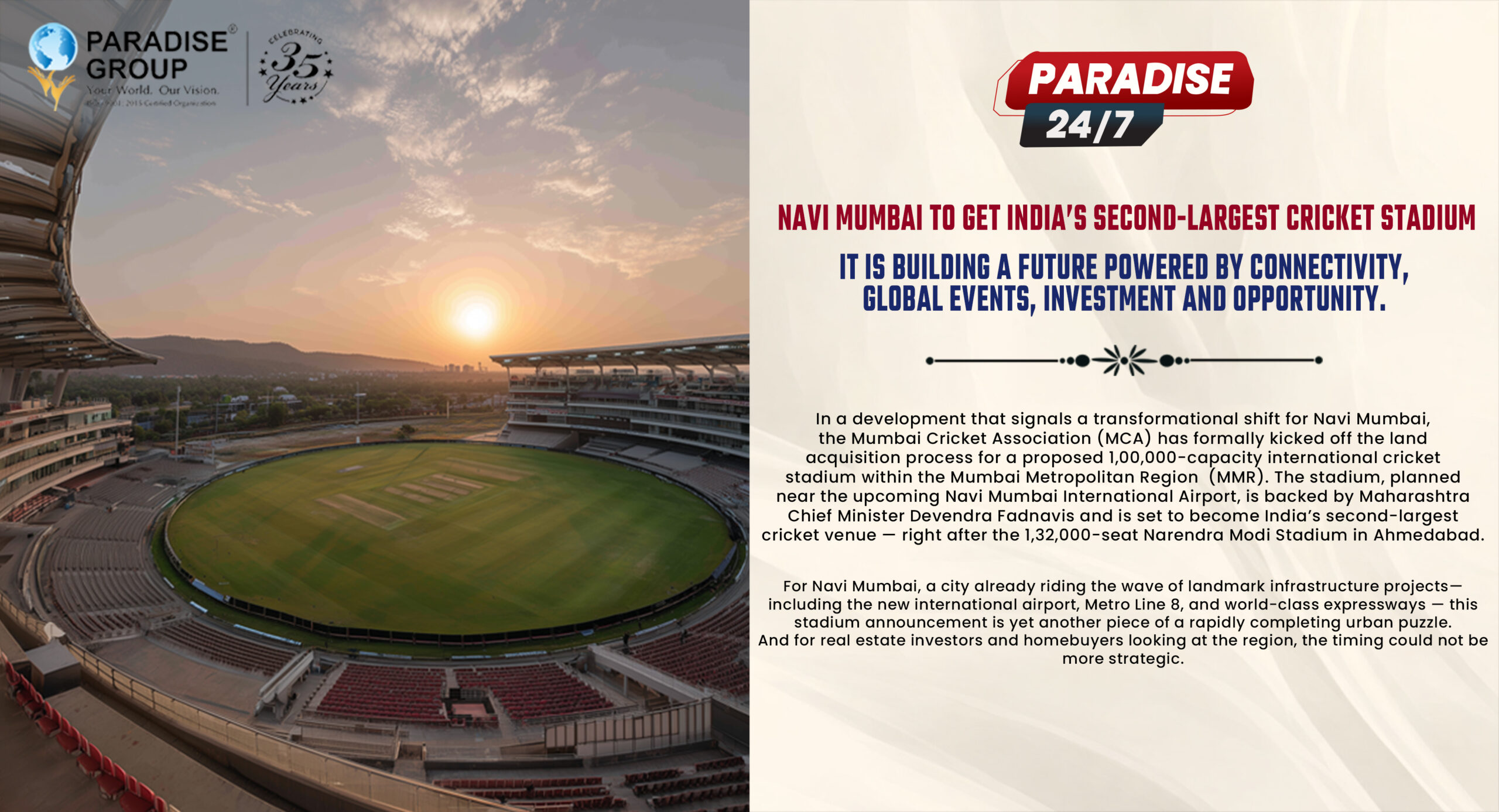
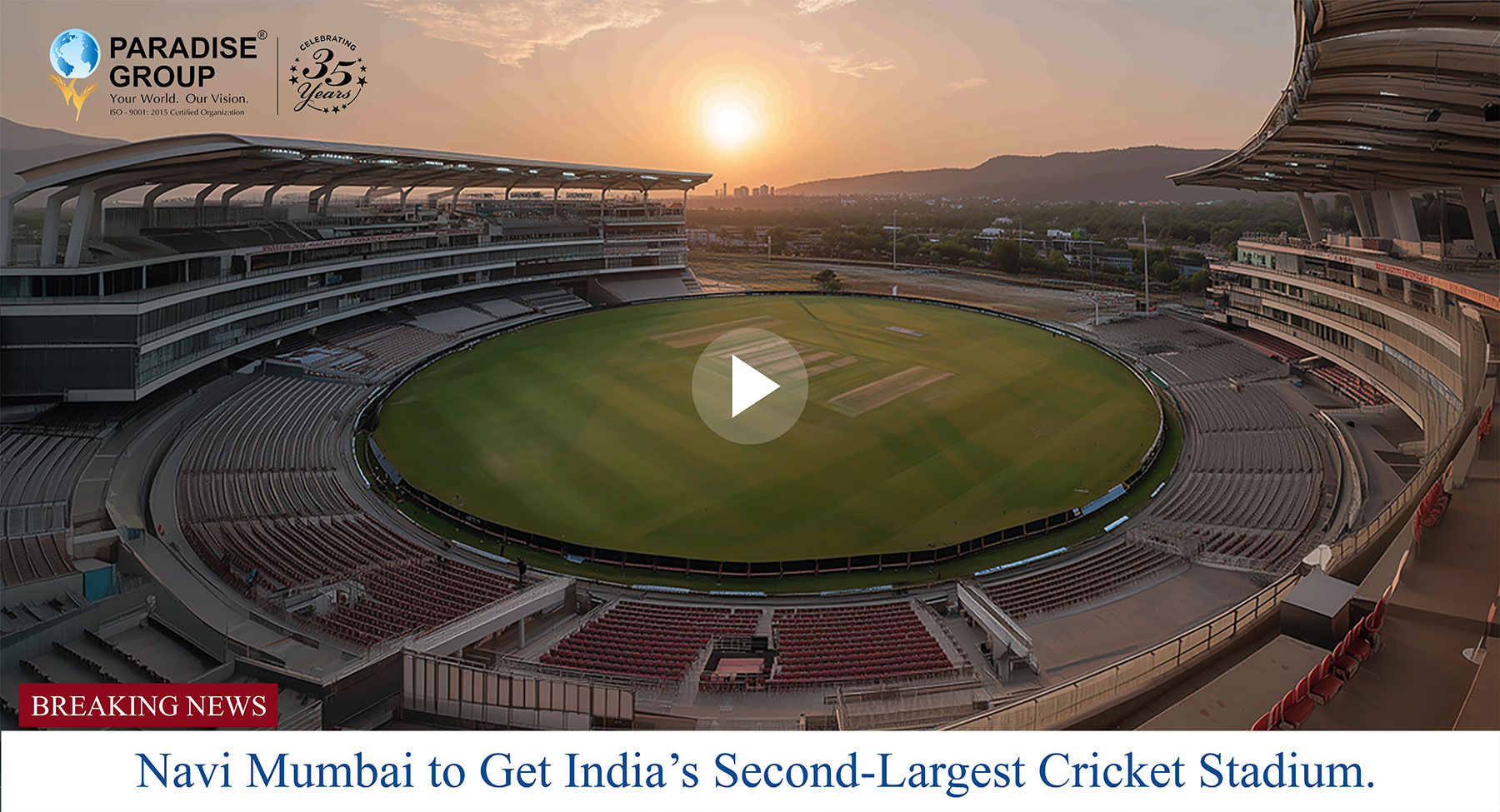
In a development that signals a transformational shift for Navi Mumbai, the Mumbai Cricket Association (MCA) has formally kicked off the land acquisition process for a proposed 1,00,000-capacity international cricket stadium within the Mumbai Metropolitan Region (MMR). The stadium, planned near the upcoming Navi Mumbai International Airport, is backed by Maharashtra Chief Minister Devendra Fadnavis and is set to become India’s second-largest cricket venue — right after the 1,32,000-seat Narendra Modi Stadium in Ahmedabad.
For Navi Mumbai, a city already riding the wave of landmark infrastructure projects — including the new international airport, Metro Line 8, and world-class expressways — this stadium announcement is yet another piece of a rapidly completing urban puzzle. And for real estate investors and homebuyers looking at the region, the timing could not be more strategic.
The Big News: What is the Navi Mumbai Cricket Stadium Project?
The Mumbai Cricket Association (MCA), under president Ajinkya Naik, has initiated formal discussions with the City and Industrial Development Corporation of Maharashtra Ltd (CIDCO) to secure a land parcel in Navi Mumbai for the proposed stadium. MCA president Naik met CIDCO Managing Director Vijay Singhal to chart the roadmap for what is expected to become one of the largest cricket stadiums in the world.
Key project highlights include:
- Proposed seating capacity: 1,00,000 spectators
- Location: Near the Navi Mumbai International Airport (Ulwe/MMR belt)
- Government backing: Maharashtra CM Devendra Fadnavis pledged land support in May 2025
- Land size: Approximately 50 acres
- Status: Land acquisition process initiated; state cabinet clearance pending
- Construction to begin: Approximately 6 months after land allotment approval
Once built, the stadium will surpass the iconic Eden Gardens in Kolkata (68,000 seats) and the DY Patil Stadium in Navi Mumbai (46,000 seats) in capacity, making it a truly world-class venue for India.
Why Navi Mumbai? The Location Advantage
The decision to site this mega-stadium near the Navi Mumbai International Airport is no coincidence. Navi Mumbai is fast emerging as one of the most strategically planned urban zones in India. With multiple infrastructure initiatives converging — metro corridors, highway upgrades, a new international airport, and now a world-class cricket stadium — the region is poised to become a global city in its own right.
The location advantages are clear:
- Direct airport connectivity makes it accessible for international cricket tours, players, and sports tourists
- Metro Line 8, connecting Mumbai’s Chhatrapati Shivaji Maharaj International Airport to Navi Mumbai Airport, will pass through key nodes like Kharghar, Nerul, and Panvel
- The Navi Mumbai-Mumbai Trans Harbour Link (Atal Setu) further cuts down travel time between South Mumbai and Navi Mumbai
- The region already has established sporting infrastructure via the DY Patil Stadium, which hosted the 2025 Women’s ODI World Cup semifinal and final
As MCA president Naik stated, a cricket stadium near the Navi Mumbai airport will be convenient for all — fans, players, officials, and broadcasters alike.
Maharashtra CM Devendra Fadnavis: The Vision Behind the Stadium
The project owes its momentum to Maharashtra Chief Minister Devendra Fadnavis, who in May 2025 publicly committed to allotting government land to the MCA for a 1-lakh-capacity stadium. At the inauguration of new stands at Wankhede Stadium — named after Ajit Wadekar, Rohit Sharma, and Sharad Pawar — Fadnavis assured the cricketing fraternity that Navi Mumbai would house a venue befitting the city’s stature.
MCA president Naik has since met Fadnavis to push for faster clearances and is now working directly with CIDCO to ensure the land allotment moves swiftly through state cabinet approval. The vision is clear: position Maharashtra as a permanent destination on the global sporting calendar.
India’s Cricket Stadium Rankings — Where Will Navi Mumbai Stand?
Once completed, the Navi Mumbai stadium will reorder India’s cricketing geography:
- 1st — Narendra Modi Stadium, Ahmedabad: 1,32,000 seats
- 2nd — Proposed Navi Mumbai International Cricket Stadium: 1,00,000 seats
- 3rd — Eden Gardens, Kolkata: 68,000 seats
- 4th — DY Patil Stadium, Navi Mumbai: 46,000 seats
- 5th — Wankhede Stadium, Mumbai: 33,108 seats
Mumbai has long punched below its weight in terms of cricket seating capacity relative to its population and passion for the sport. The new stadium is the answer to that long-standing gap.
What This Means for Navi Mumbai Real Estate
A 1-lakh-seater stadium will attract thousands of cricket fans, sports tourists, broadcasters, sponsors, and officials to the region on a regular basis. This demand drives up the need for hotels, serviced apartments, and residential housing in surrounding areas. Kharghar, Nerul, Panvel, and Upper Kharghar — the emerging residential corridors of Navi Mumbai — stand to benefit most directly.
Stadiums of this scale are catalysts for commercial real estate. Food and beverage, sports retail, hospitality, and entertainment zones typically spring up around large venues. The stadium’s location near the Navi Mumbai International Airport further amplifies this commercial pull.
Proximity to sports infrastructure has historically driven property value appreciation in global cities. With this stadium combining airport adjacency, metro connectivity, and international-grade sporting infrastructure, properties in the Navi Mumbai-Panvel-Kharghar corridor are positioned for strong long-term appreciation.
Paradise Group Projects: Perfectly Positioned to Benefit
Located in Navi Mumbai’s fastest-growing node, Sai World Empire will benefit from the combined boost of Metro Line 8 connectivity and the new stadium’s economic halo effect. Kharghar’s proximity to key transport corridors and its established social infrastructure make it one of the most sought-after residential destinations in MMR.
Offering premium lifestyle residences and commercial office spaces, Sai World One in Nerul is directly in the path of the stadium’s connectivity-driven uplift. Nerul is one of the nodal stops on Metro Line 8 and sits well within the stadium’s catchment zone, making it ideal for professionals and investors.
Positioned in one of Navi Mumbai’s most dynamically developing micro-markets, Sai World Pyramid stands to gain from rising demand as Nerul transforms into a key sports and commercial hub alongside the new stadium development.
An ultra-premium residential development on Palm Beach Road, Sai Palm View combines aspirational living with exceptional connectivity. As the stadium drives footfall and economic activity across the Palm Beach Road corridor, this address will only grow in stature and value.
This premium self-sustained township in Panvel is strategically placed near the Navi Mumbai International Airport and the proposed stadium corridor. For buyers seeking a future-ready, integrated living environment, Sai World City represents a compelling long-term investment.
With direct benefits from infrastructure growth in the Kharghar-Panvel belt, Sai Sun City offers homebuyers the twin advantages of connectivity and appreciation potential, especially as the stadium and airport development gather pace.
Shilphata Corridor While slightly further from the stadium site, Sai World Dreams benefits from the broader infrastructure wave sweeping the MMR. The Kalyan-Dombivli belt’s rapid development — driven by road and metro networks — makes this project an attractive option for buyers seeking affordability with growth potential.
Offering comfort, connectivity, and strong appreciation prospects, Sai Platinum in Kharghar is well-placed to capture demand from families and first-time homebuyers drawn to Navi Mumbai’s evolving urban landscape.